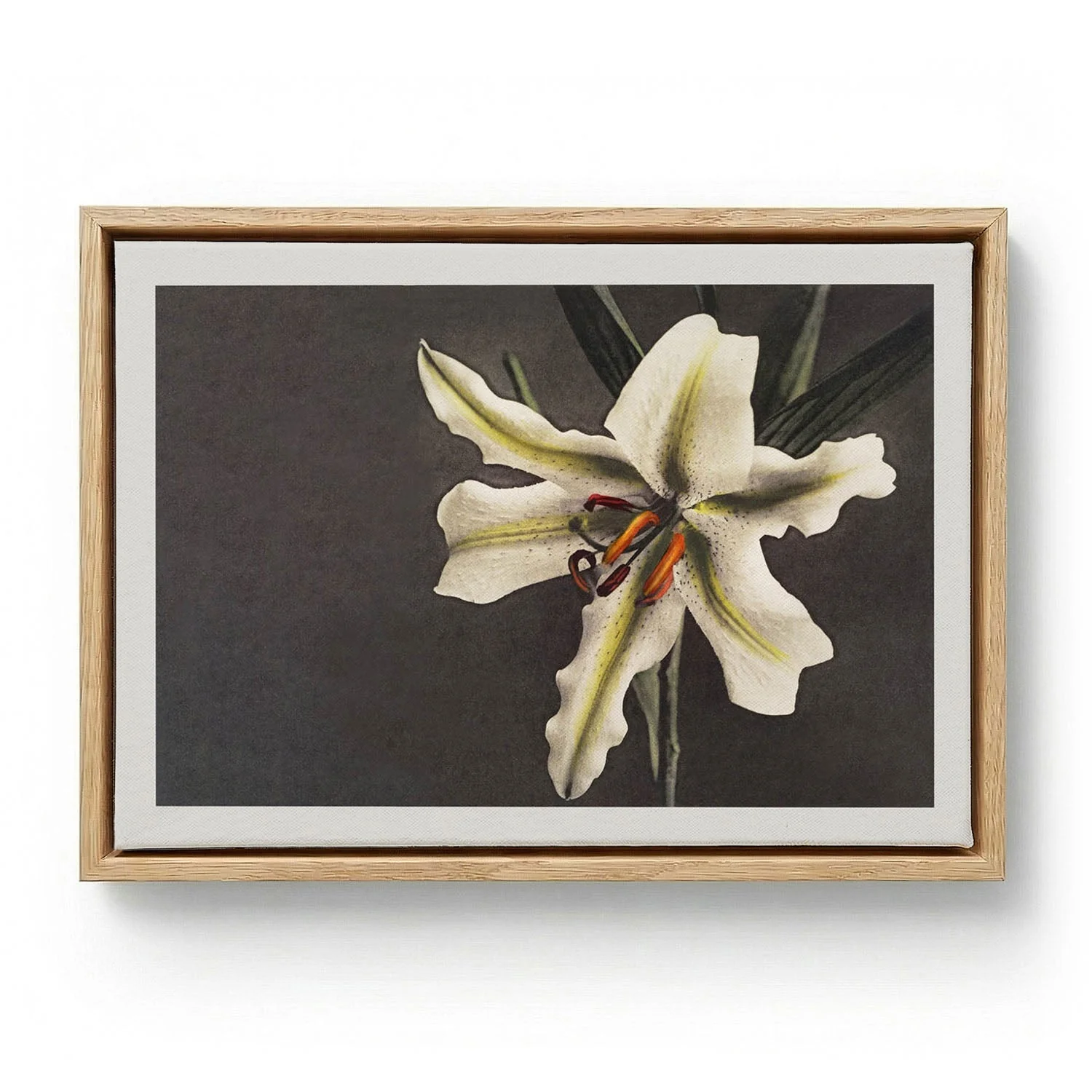
White Lily in the Dark by Ogawa Kazumasa
In White Lily in the Dark, Ogawa Kazumasa isolates a single lily against deep shadow, stripping the image down to its essential contrast. The photograph comes from his Meiji-era botanical series, where Western printing methods met Japanese aesthetic restraint. The result is an image that reads simultaneously as scientific record and refined art — spare, precise, quietly extraordinary.
Canvas suits Kazumasa's contrast. The weave deepens the black ground into a softer, more painterly dark and warms the isolated lily against it, adding tactile weight to the image's precision. As a canvas print, the Meiji-era photograph reads less as scientific record and more as a quiet tonal study — spare, refined, and carried on a textured surface that feels genuinely handled.
In White Lily in the Dark, Ogawa Kazumasa isolates a single lily against deep shadow, stripping the image down to its essential contrast. The photograph comes from his Meiji-era botanical series, where Western printing methods met Japanese aesthetic restraint. The result is an image that reads simultaneously as scientific record and refined art — spare, precise, quietly extraordinary.
Canvas suits Kazumasa's contrast. The weave deepens the black ground into a softer, more painterly dark and warms the isolated lily against it, adding tactile weight to the image's precision. As a canvas print, the Meiji-era photograph reads less as scientific record and more as a quiet tonal study — spare, refined, and carried on a textured surface that feels genuinely handled.
Description
In White Lily in the Dark, Ogawa Kazumasa isolates a single lily against deep shadow, stripping the image down to its essential contrast. The photograph comes from his Meiji-era botanical series, where Western printing methods met Japanese aesthetic restraint. The result is an image that reads simultaneously as scientific record and refined art — spare, precise, quietly extraordinary.
Canvas suits Kazumasa's contrast. The weave deepens the black ground into a softer, more painterly dark and warms the isolated lily against it, adding tactile weight to the image's precision. As a canvas print, the Meiji-era photograph reads less as scientific record and more as a quiet tonal study — spare, refined, and carried on a textured surface that feels genuinely handled.