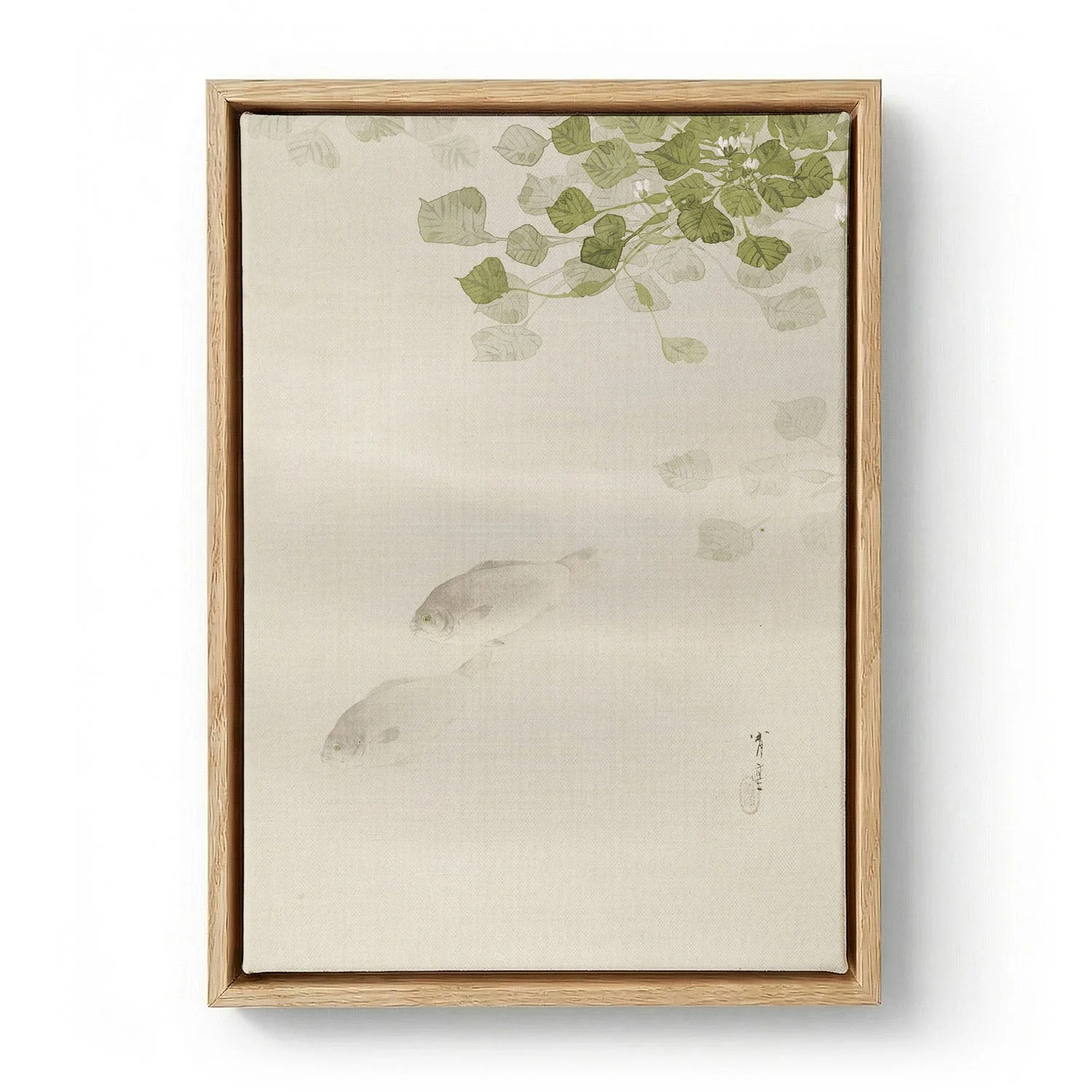
Fish (1887) by Watanabe Seitei
Fish glide through water rendered as pure, unweighted space — Seitei depicts them without background clutter, letting body shape and scale relationships carry the entire composition. Painted in 1887, this study in aquatic form reflects both the kacho-ga tradition's reverence for natural subjects and the observational acuity Seitei developed alongside European naturalists. The fish are positioned across the picture plane with an almost choreographic sense of interval, each one complete yet clearly in motion relative to the others.
The subtle tonal layers and atmospheric depth of this composition translate naturally to canvas, where the surface texture adds warmth and dimensionality — a canvas print that brings out the painterly richness of the original.
Fish glide through water rendered as pure, unweighted space — Seitei depicts them without background clutter, letting body shape and scale relationships carry the entire composition. Painted in 1887, this study in aquatic form reflects both the kacho-ga tradition's reverence for natural subjects and the observational acuity Seitei developed alongside European naturalists. The fish are positioned across the picture plane with an almost choreographic sense of interval, each one complete yet clearly in motion relative to the others.
The subtle tonal layers and atmospheric depth of this composition translate naturally to canvas, where the surface texture adds warmth and dimensionality — a canvas print that brings out the painterly richness of the original.
Original: $53.50
-65%$53.50
$18.72Description
Fish glide through water rendered as pure, unweighted space — Seitei depicts them without background clutter, letting body shape and scale relationships carry the entire composition. Painted in 1887, this study in aquatic form reflects both the kacho-ga tradition's reverence for natural subjects and the observational acuity Seitei developed alongside European naturalists. The fish are positioned across the picture plane with an almost choreographic sense of interval, each one complete yet clearly in motion relative to the others.
The subtle tonal layers and atmospheric depth of this composition translate naturally to canvas, where the surface texture adds warmth and dimensionality — a canvas print that brings out the painterly richness of the original.